 |
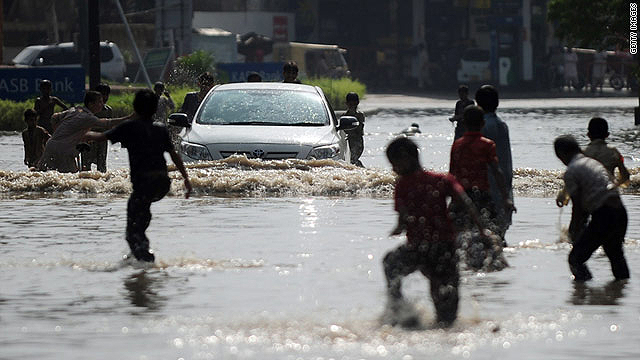
| Pakistani youths play in a flooded street after heavy rains in Karachi on September 11, 2011 (CNN) -- U.N. aid agencies are assisting in relief efforts in southeastern Pakistan after flooding caused by heavy rains killed almost 200 people and destroyed or damaged more than one million homes, the United Nations said.About 200,000 people have been displaced by the flooding and need immediate assistance, the U.N. Office for the Coordination of Humanitarian Affairs said in a statement released Saturday. Joint U.N.-Pakistani teams are on the ground in the region to assess the damage, said Timo Pakkala, the U.N. Humanitarian Coordinator in Pakistan. Torrential rains during the annual monsoon season have inundated an estimated 4.2 million acres of land, the U.N. said. |
Monday, 12 September 2011
Pakistan flooding kills 200, damages almost 1 million homes, U.N. says

BBC News - India probes child HIV cases after blood transfusions

An investigation has been launched into how 23 children who received regular blood transfusions have tested positive for HIV in the Indian state of Gujarat.

The children suffer from thalassaemia and get their blood transfusions at a public hospital in Junagadh district.
Hospital authorities have denied that the children were infected by their blood supplies.
But state authorities have launched a probe after routine tests of nearly 100 children revealed the latest cases.
About 2.5m people in India have the HIV virus, according to UN-backed government figures. Gujarat, along with Bihar and Uttar Pradesh, account for 22% of HIV infections in India.
The 23 infected children in the latest case are aged between five and 10 years.
They showed positive for HIV following recent tests of nearly 100 children suffering from thalassaemia and who receive blood transfusions at the hospital twice a week.
Gujarat Health Minister Jay Narayan Vyas said that the children may have been infected after receiving transfusions "at some other places".
He also said some pre-transfusion tests at the hospital had found that the children already had HIV.
But the parents of the infected children insist that they only ever got transfusions at the Junagadh government hospital.
"We have never gone anywhere else [for blood transfusions]. How can they (authorities) say that children were affected with the virus before getting registered?," Salim Sheikh, the father of one child, told The Indian Express newspaper.
Indian authorities say the number of annual new HIV infections has declined by more than 50% during the last decade.

BBC News - France nuclear: Marcoule site blast kills one
One person has been killed and four injured, one seriously, by a blast at the Marcoule nuclear site in France.

There was no risk of a radioactive leak after the blast, caused by a fire near a furnace in the Centraco radioactive waste storage site, said officials.
The plant's owner, national electricity provider EDF, said it had been "an industrial accident, not a nuclear accident".
There are no nuclear reactors at the southern French site.
The explosion hit the area at 11:45 local time (09:45 GMT).
"For the time being nothing has made it outside," said a spokesman for France's Atomic Energy Commission (CEA).
The Centraco treatment centre belongs to a subsidiary of EDF. It produces MOX fuel, which recycles plutonium from nuclear weapons.
The EDF spokesman said the furnace affected had been burning contaminated waste, including fuels, tools and clothing which had been used in nuclear energy production.
"The fire caused by the explosion was under control," he said.
The International Atomic Energy Agency (IAEA) said it was in touch with the French authorities to learn more about the nature of the explosion.
Director General Yukiya Amano said the organisation's incident centre had been "immediately activated", Reuters reports.
Nuclear power meets 75% of France's energy needs.
Marcoule was opened in 1955 and is one of France's oldest nuclear sites, though it has been extensively modernised.
It is located in the Gard department in Languedoc-Roussillon region, near France's Mediterranean coast.
All the country's 58 nuclear reactors have been put through stress tests in recent months, following the disaster at Japan's Fukushima nuclear plant which was hit by an earthquake and tsunami.
EDF's share prices fell by more than 6% as news of the blast emerged.
-------------------------------------------------
Analysis

The French nuclear programme does not have a stellar record of transparency. In environmental circles, particular opprobrium is reserved for officials who in 1986 claimed the Chernobyl accident would have no impact on France - a statement lampooned as indicating officials believed radioactive fallout observed national boundaries.
What this incident implies for the future of the French nuclear programme is not entirely clear. If it remains a relatively minor matter, it will probably be passed off as the type of thing that regrettably happens in all types of industrial facility.
However, Marcoule is on the list of candidate sites to host one of the European Pressurised Water Reactors (EPRs) that according to government policy are to provide the next generation of French citizens with nuclear electricity.
Friday, 2 September 2011
the photosss of the day :) (national geographic)

Blacktip Shark
Photograph by Brian J. Skerry, National Geographic
The fin of a blacktip shark slices the water's surface.

Polar Bear, Canada
Photograph by Norbert Rosing, National Geographic
A polar bear sleeps on the ice in Canada.

SEPTEMBER 2, 2011
Easter Procession, Spain
Photograph by Carolina Sanchez Monge, My Shot

Congo Family, Republic of the Congo
Photograph by Michael Nichols, National Geographic

Archeï Oasis, Chad
Photograph by George Steinmetz, National Geographic
August 23, 2006
Knee-deep wading is bliss for camels in Chad's Archeï, a canyon whose trapped waters hold a zoological surprise. Fertilized by beasts' droppings, algae are eaten by fish that are preyed upon by an isolated group of crocodiles.
Subscribe to:
Posts (Atom)